


A New Era of Engineering: Model-Based Systems Engineering
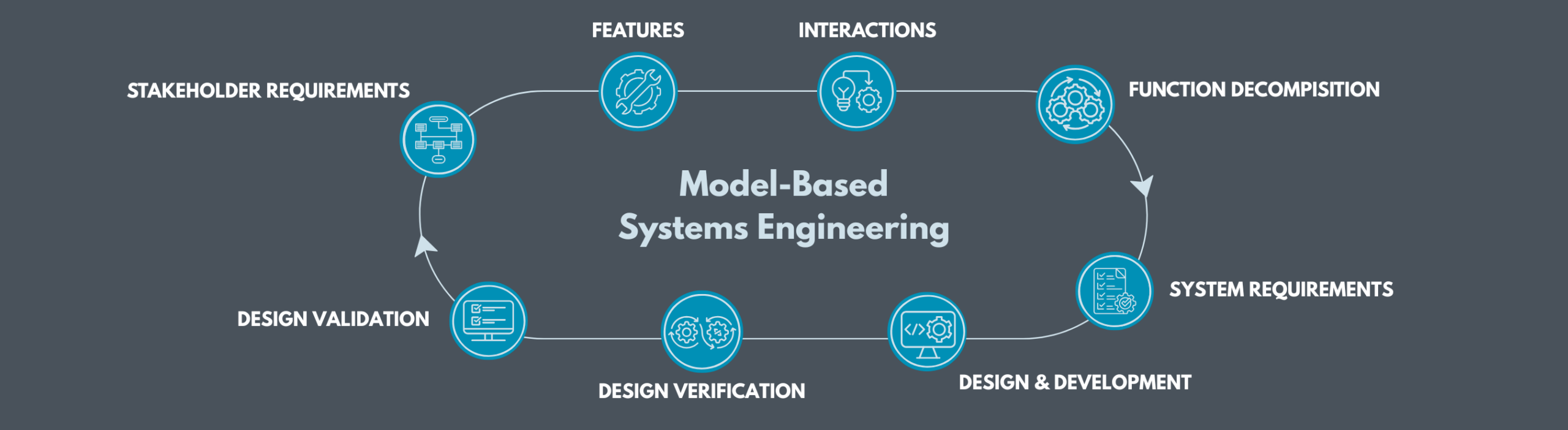
In the world of systems engineering, the development of Model-Based Systems Engineering (MBSE) represents a significant transformation. MBSE is redefining how complex systems are described, designed, tested and delivered. A new era in engineering is here: an era of efficiency, collaboration and innovation.
In the medical device industry, engineers rely heavily on documentation. MBSE transforms our approach by providing teams with dynamic, digital models. The models serve as a single source of truth that helps every team member understand relationships and how value is created. By creating digital representations, teams can see how every part of a system fits and works together.
Here are six ways MBSE helps us work more efficiently as a team and for our clients.
1. It helps us spot problems early.

“With MBSE, we’re able to find the root cause and de-risk a design more efficiently than ever before.” — Mia Huffman, Technical Project Manager
MBSE provides models that are interconnected. This allows engineers to quickly evaluate and assess system requirements and identify issues long before traditional documentation would reveal a problem.
When something fails using a traditional approach, engineers are left to think: Could it be XYZ or ABC? With MBSE, the system is so interconnected that the team can see that X relates to A, Y relates to B and Z relates to C. For example, if there’s a mismatch between a usability need and a design decision, MBSE highlights it clearly. On paper, everything might look correct, but the model exposes hidden gaps that could lead to failure down the line.
2. It makes the complex simple.

“MBSE provides a multi-dimensional view of a system. It can show the structural layers of the system as well as capture how the system changes across the different stages of a life cycle.” — Julia Le, Systems Engineer and Technical Project Manager
Through MBSE, engineers can create workable models that capture the fundamental components of the system, such as architecture, requirements and behavior. This allows engineers to reduce risks and identify problems earlier in the development process.
3. It’s a centralized blueprint.
“MBSE is a living, digital blueprint that keeps all the moving parts aligned.” — Mia Huffman, Technical Project Manager
At its core, MBSE centralizes system data and provides a shared platform for communication between team members and stakeholders, breaking down silos and enhancing collaboration. In large-scale projects, where 60 to 70 engineers may be involved, MBSE’s ability to put everything in one place becomes critical.
4. It helps us work together.

“A model system shows how one person’s work will interact with or complement another person’s work, enabling everyone to understand how you’re working toward the end goal of creating something.” — Maanav Kapur, Systems Engineer
A visual, digital model reduces uncertainty and unifies stakeholders around a common understanding of how the system is built and how it will function. The architecture, requirements and behavior of a model system are all combined into one system representation with MBSE using digital tools and documents. This enables everyone to use the same artifacts and work from the same source.
5. It speeds up the process.
“MBSE could help speed up the time it takes for us to get treatments to patients faster. Not only faster, but safer.” — Mia Huffman, Technical Project Manager
The impact of MBSE is transformative in industries like medical device engineering, where bringing a device to market can take years and involve hundreds of pages of documentation. MBSE helps streamline this process and establish relationships between deliverables.
6. It makes us more agile.
“Our process is inherently resilient because our systems engineering approach considers the whole system. Everything is made even more agile with MBSE.” — Tanner White, Systems Engineer

Our ability to adapt and build solutions that are resilient is enhanced by MBSE. We’re able to make better decisions, faster. Our processes are more centralized and consistent. We can quickly respond to the needs of both our teams and our stakeholders, providing our clients the exact value and solution they seek.
Here at ASG, we’re excited to expand our capabilities with MBSE. As MBSE continues to evolve, so do the organizations that adopt it. MBSE doesn’t just change the way we document systems; it transforms the way we think, collaborate and impact the future.
Learn more about who we are and what we do.